
# Advanced search
Configures the Advanced and Basic search in DMSforLegal: where to search, the search input fields, the result columns and the search refiners (faceted search). Advanced search uses SharePoint search managed properties.
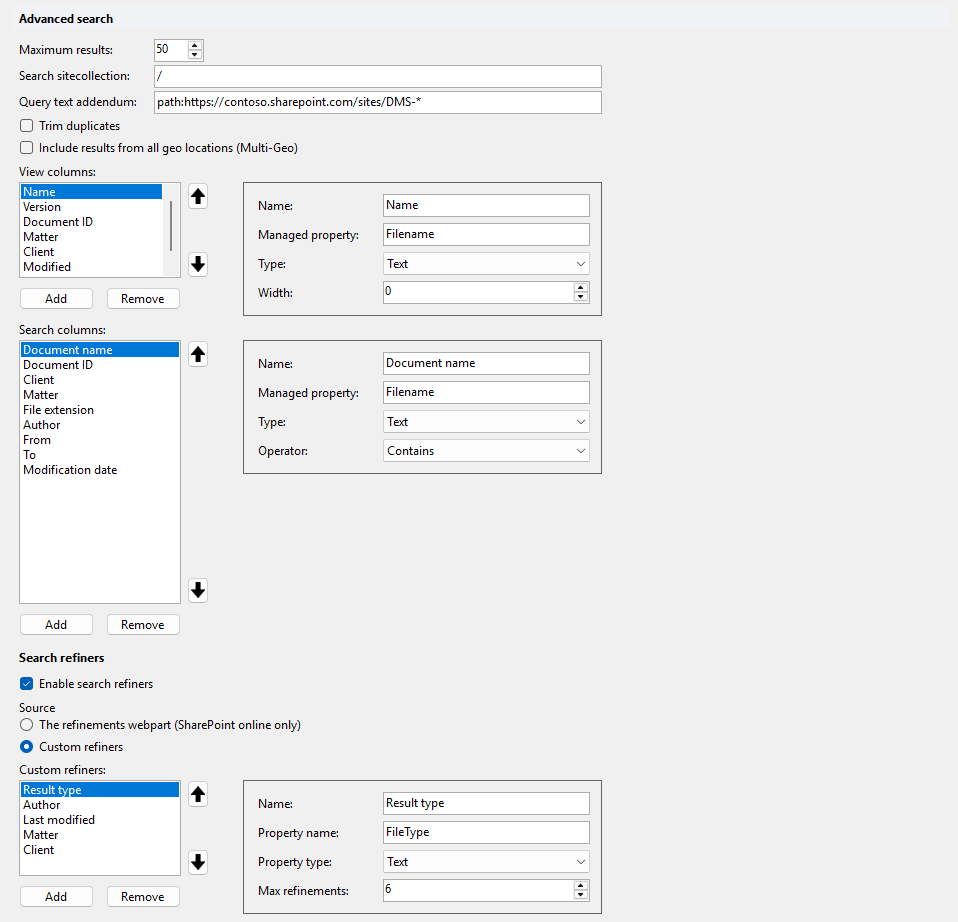
# Maximum results
Maximum number of results returned when a search query runs. Default: 50.
# Search sitecollection
Site collection to search in. Default: /. Enter a site collection URL to search in that site collection only.
# Query text addendum
Text added to every search query. Default: empty. Example: path:https://yourtenant.sharepoint.com/Matter/*.
Use it to exclude sites from the results, for example -ParentLink:"/sites/EponaContracts/dStyle".
# Trim duplicates
Filters duplicate search results. Default: off.
# Include results from all geo locations (Multi-Geo)
Includes search results from all geo locations of a Multi-Geo tenant. Default: off.
# View columns
Result columns visible in Advanced or Basic search. Use the arrow buttons to change the column order. On SharePoint Online, Add all adds Name, Version, Document ID, Matter, Client, Modified and Modified By.
| Property | Description |
|---|---|
| Name | Column header. |
| Managed property | SharePoint search managed property shown in the column. |
| Type | Field type. |
| Width | Column width. 0 uses the available width. |
The Type changes how a result value is shown, within the limits of what DMSforLegal can show differently. For example, if a managed property returns 0 and 1, type Boolean shows them as False and True instead of integers.
When a view column stays empty in Outlook, the managed property may have a problem in SharePoint. Or the user changed the Outlook view to include a field, for example From, that is not configured here. To reset the Outlook view to the configured view, right-click in Outlook and choose Reset View.

# Search columns
Map SharePoint managed properties to input fields in the DMSforLegal Advanced Search dialog. Use the arrow buttons to change the field order. On SharePoint Online, Add all adds Document name, Document ID, Client, Matter, File extension, Author, From, To and Modification date.
| Property | Description |
|---|---|
| Name | Label of the input field on the form. |
| Managed property | SharePoint search managed property to search in. |
| Type | Field type: Text, Integer, DateTime, Boolean, User, Url, Choice, MultiChoice, Lookup, Taxonomy, Client or Matter. |
| Operator | Contains (default) or Equals. Not shown for Lookup, Taxonomy, Choice and MultiChoice fields. |
| Lookup list URL | URL of the lookup list. Lookup fields only. |
| Lookup column | Column of the lookup list. Lookup fields only. |
| Term store | Term store. Taxonomy fields only. Use the browse button to pick it. |
| Term set | Term set. Taxonomy fields only. Use the browse button to pick it. |
| Term anchor | Term anchor. Taxonomy fields only. Use the browse button to pick it. |
| Choices | Choices offered to the user, each with a Name and a Value. Choice and MultiChoice fields only. Example: Name Word documents, Value docx doc rtf. |
# Search refiners
Search refiners (faceted search) let users narrow the search result set. A field can only be used as a refiner if it is searchable and refinable in SharePoint search.
# Enable search refiners
Shows search refiners. Default: enabled.
# The refinements webpart (SharePoint online only)
Under Source: read the refiner configuration from the refinements webpart. Works only in SharePoint Online. This is the default source.
# Custom refiners
Under Source: configure the refiners manually in the Custom refiners list. These refiners must also be configured in SharePoint. When you select this option and the list is empty, it is filled with Result type, Author, Last modified, Matter and Client. Add all selects this option.
| Property | Description |
|---|---|
| Name | Caption of the refiner. |
| Property name | SharePoint search managed property, for example FileType. |
| Property type | Field type. Default: Text. |
| Max refinements | Maximum number of refinement values shown. Default: 5. |